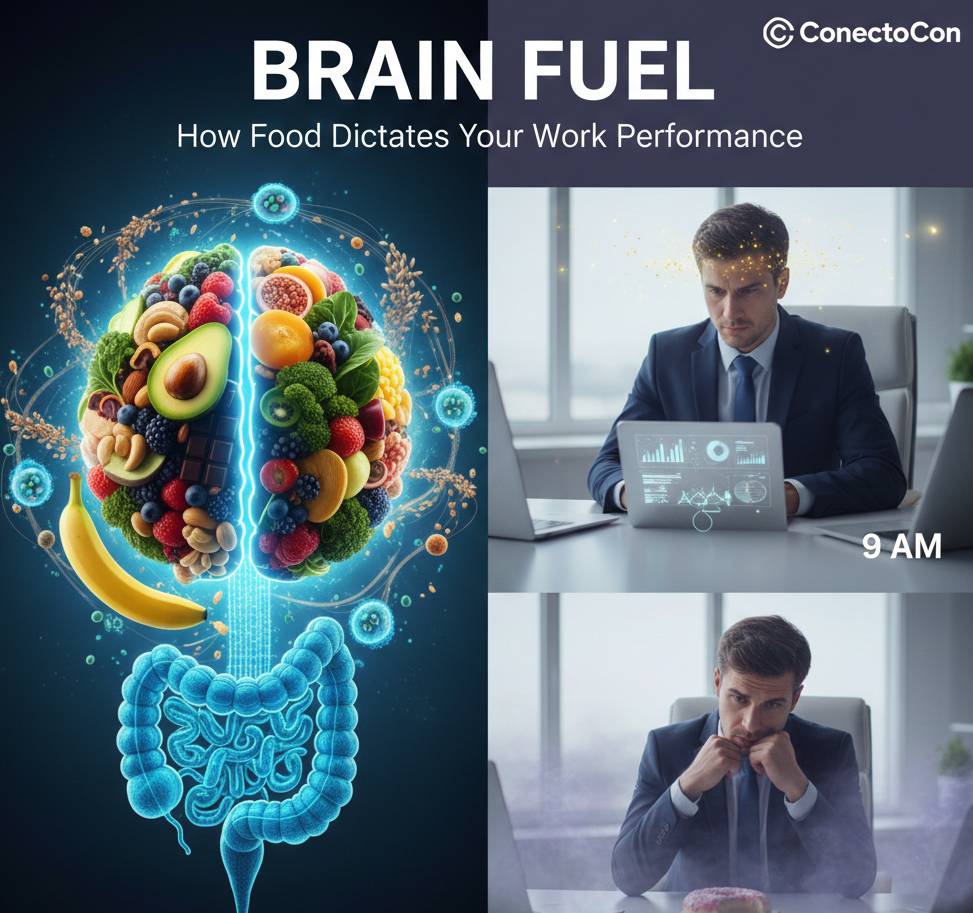
Have you ever wondered why, despite your best intentions, your focus vanishes at 3 PM? It is rarely a lack of willpower. In fact, it is a chemical reaction. Every meal sends a signal to your brain that either stabilizes your “executive function” or triggers a state of metabolic stress. To perform at a high level, you must understand the cause and effect of what you consume and how it acts as your Brain Fuel.
1. The Glucose Spike: The Enemy of Deep Work
What you eat: Refined carbohydrates (white bread, pasta) or sugary snacks.
The biological effect: Your blood sugar rises rapidly, causing a massive release of insulin.
The impact on work:
The “Sugar High”: For 30 minutes, you feel energized.
The Crash: As insulin clears the sugar, your Brain Fuel drops below baseline.
The Result: You experience “brain fog,” irritability, and a sudden inability to process complex data. Your brain literally enters a low-power mode.
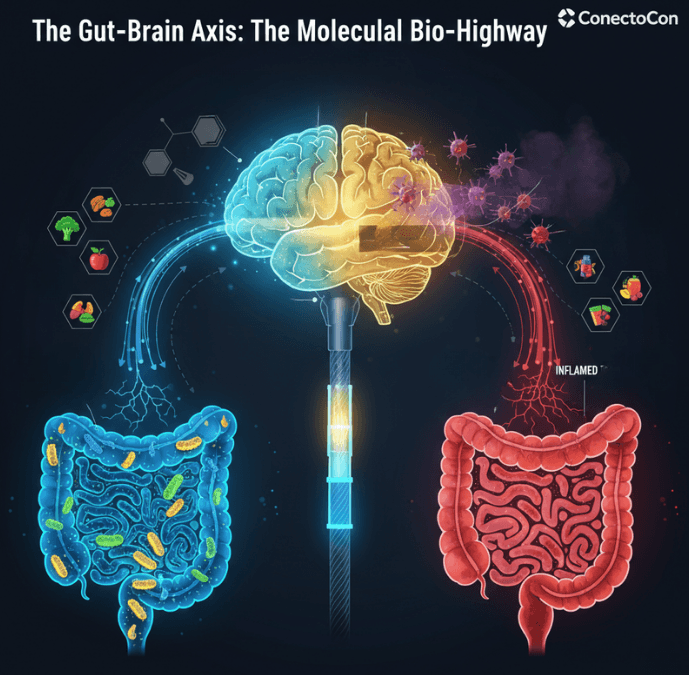
2. Microbiome and Mood: The Gut-Brain Highway
What you eat: Ultra-processed foods lacking fiber.
The biological effect: In your “Super Gut,” certain bacteria thrive on sugar and inflammatory fats. These microbes send signals through the vagus nerve directly to your emotional center.
The impact on work:
Neurochemical Hijacking: These bacteria can mimic neurotransmitters like dopamine, forcing you to “crave” distractions or more sugar instead of focusing on your tasks.
Inflammation: A poor microbiome leads to systemic inflammation, which slows down neural communication. You become “biologically slower” at solving problems.
3. The Dopamine Circuit: Motivation vs. Exhaustion
What you eat: A balanced intake of amino acids (found in quality proteins) and healthy fats.
The biological effect: You provide the “raw materials” for neurotransmitters. Tyrosine becomes dopamine; Tryptophan becomes serotonin.
The impact on work:
Sustained Drive: Dopamine is the essential Brain Fuel for motivation. With steady levels, your brain’s reward system is naturally engaged with your goals.
Decision-Making Clarity: Healthy fats (Omega-3s) protect the integrity of your neurons, allowing for faster and more accurate decision-making under pressure.
Debunking the “Gluten Lie” and Productivity Fads
It has become common to blame specific ingredients for our lack of energy. However, we must separate scientific reality from marketing myths. In “The Gluten Lie”, Alan Levinovitz, PhD, argues that many modern food fears lack a solid clinical foundation.
Consequently, your productivity is not just about discipline—it is about the quality of the Brain Fuel you provide to your nervous system. Are you energized for deep work, or are you sabotaging your next deadline?
Glucose Control: The Architecture of Mental Clarity
Your brain is an energy-intensive organ, utilizing about 20% of your daily calories. Therefore, the speed at which this Brain Fuel enters your bloodstream is crucial for high performance.
The Crash Cycle: High-sugar snacks or refined carbohydrates cause a rapid glucose spike, followed by a sudden surge in insulin.
The Result: This energy crash deprives your brain of constant fuel, leading to the dreaded 3 PM slump.
The Solution: By consuming complex fibers and healthy fats—those that promote a “Super Gut”—you ensure a slow and steady energy burn that lasts even through the most demanding meetings.
Conclusion: Becoming the Architect of Your Focus
In summary, peak professional performance is not a mystery; it is a biological result of choosing the right Brain Fuel. By understanding the link between microbiome restoration and cognitive stability, you stop being a victim of energy crashes.
Ultimately, you are the one in control of your internal chemistry. The next time you choose your meal, ask yourself: Is this feeding my ambition, or just my hunger?
Find the 5 hidden terms from our Brain Fuel study.
📚 Click to see scientific references
DAVIS, William. Super Gut: A Four-Week Plan to Reprogram Your Microbiome, Restore Health, and Lose Weight. 1. ed. New York: Hachette Go, 2022.
LEVINOVITZ, Alan. The Gluten Lie: And Other Myths About What You Eat. 1. ed. New York: Regan Arts, 2015.
NAIDOO, Uma. This Is Your Brain on Food: An Indispensable Guide to the Surprising Foods that Fight Depression, Anxiety, PTSD, OCD, ADHD, and More. 1. ed. Boston: Little, Brown Spark, 2020.
* Technical analysis and review based on nutritional neuroscience and the gut-brain axis.