

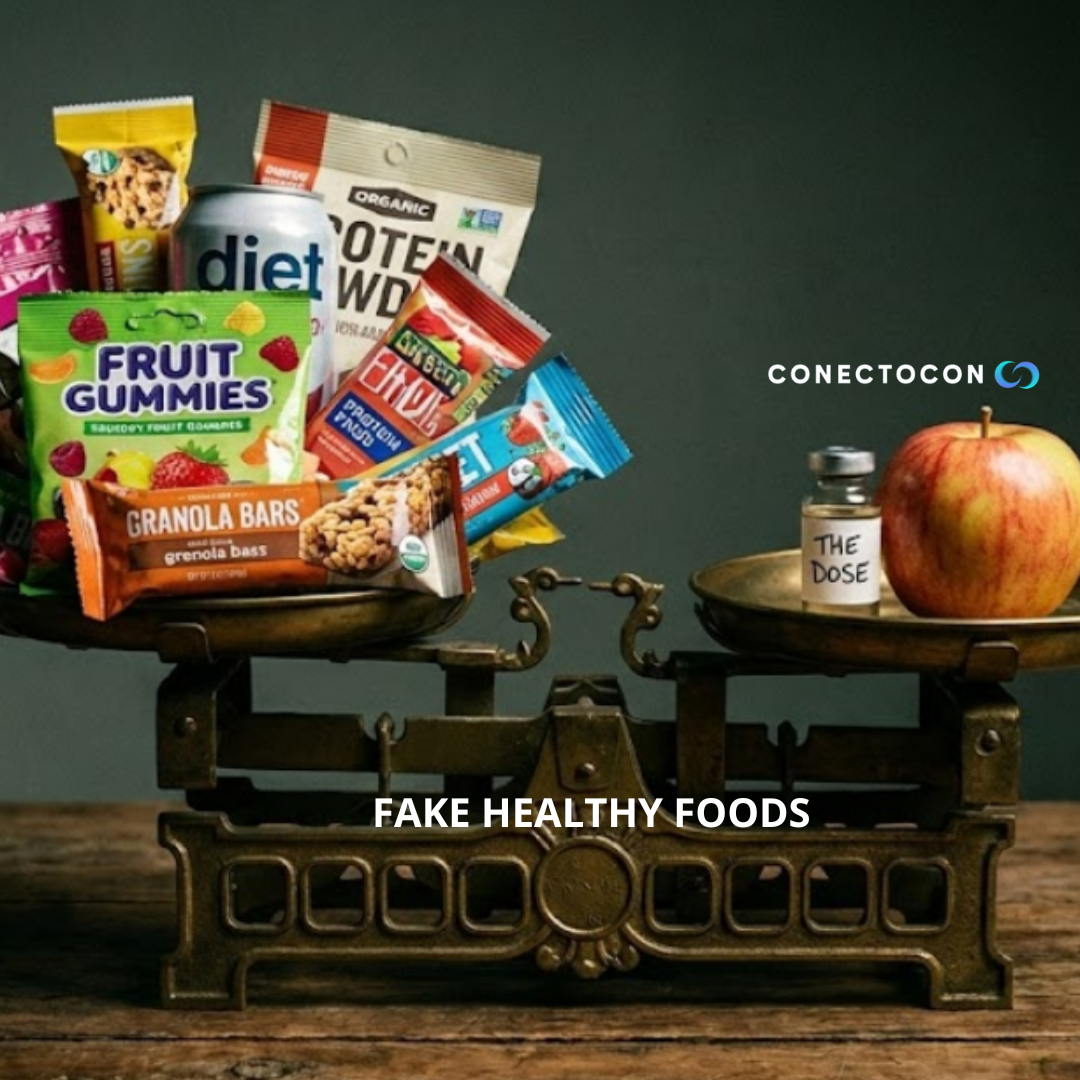
Walk down any supermarket aisle, and you will be immediately bombarded by green packaging and bold promises. “Zero Fat.” “Rich in Vitamins.” “All Natural.” We eagerly fill our carts, believing we are making the best choices for our bodies.
However, a revolution is currently happening in the scientific community and within regulatory agencies like the US FDA.
Here is the truth:
Many universally accepted products are actually fake healthy foods. Today, nutritional science is exposing the grand illusion of food marketing and fundamentally redefining what truly sustains human biology.
Find the 6 hidden terms from our Fake Healthy Foods article.
The Hidden Threat: Chemical Residues and Food Engineering
A food’s health profile is not just about its basic macronutrients (carbs, proteins, and fats). As a researcher analyzing human metabolism and physiology, I look at food through a different lens.
When you truly understand functional nutrition, one undeniable fact emerges: the origin and processing of the food matrix are absolutely crucial.
A perfectly crisp apple or a vibrant bowl of spinach is biologically beneficial. However, if those crops are heavily burdened with agrochemicals, pesticides, and chemical preservatives during production, their nutritional value sharply declines.
The crazy part?
We are not just eating the plant. We are actively ingesting the microscopic chemical history of its cultivation.
Furthermore, modern food engineering frequently removes natural fibers and complex structures from raw ingredients. They replace these vital elements with synthetic additives just to extend shelf life. Consequently, a product can legally claim to be “low calorie” while carrying artificial emulsifiers that severely disrupt our gut microbiome.
The “Fake Health” Foods We Consume Daily
Because of outdated labeling laws, the food industry has historically hijacked the word “healthy.” According to recent critical reviews by public health researchers, many widely consumed products are riding on false health halos.
Let’s look at a few classic examples:
Commercial Granola and Cereal Bars: Often marketed as fitness essentials. In reality, many are bound together by high-fructose corn syrup and processed oils, acting closer to a candy bar in your bloodstream.
Packaged Fruit Juices: Once the vital fiber is removed, what remains is a concentrated hit of liquid fructose. This spikes insulin levels almost as rapidly as a regular soda.
Veggie Chips: The word “veggie” tricks the brain. Yet, the extreme processing, deep-frying in inflammatory seed oils, and high sodium content completely eliminate the original vegetable’s benefits.
The FDA’s Awakening and the New Definition of Health
The scientific consensus is finally forcing necessary regulatory changes. Agencies like the US Food and Drug Administration (FDA) are actively working to redefine the “healthy” claim on food labels. This shift aims to align with current, evidence-based nutrition science.
Recent studies highlight that assessing food solely by isolated nutrients is a deeply flawed approach. Simply adding synthetic Vitamin C to a sugar-laden beverage does not magically transform it into a health tonic.
So, what does science actually define as healthy today?
Whole Food Matrix: Foods that retain their original biological structure, allowing our bodies to digest them as nature intended.
Nutritional Density Over Calorie Counting: Foods rich in bioavailable vitamins, minerals, and phytonutrients, rather than empty calories manufactured in a lab.
Minimal Chemical Load: Ingredients grown with profound respect for the natural ecosystem, minimizing pesticide residues and avoiding ultra-processing.
True health cannot be manufactured in a laboratory and slapped on a plastic wrapper. It is found in the complex, unaltered, and balanced biodiversity of real food. Next time you shop, look past the marketing and choose what nature actually designed for your body.
The Good News: Your Biological Resilience and Moderation
Let’s be completely honest. Many of these ultra-processed, “fake healthy foods” are undeniably delicious.
However, you do not need to banish them from your life forever.
Here is the good news:
The human body is an incredibly resilient biological machine. If you consume these less nutritious foods in strict moderation, your body easily adapts. Our natural detoxification pathways—like the liver and kidneys—can efficiently process and clear out small amounts of dietary stress without causing long-term harm.
Remember the Paracelsus principle we discussed earlier?
The dose truly makes the poison. Eating a small amount of an ultra-processed treat occasionally will not destroy your health. The danger only arises when these engineered products become the foundation of your daily diet, rather than a rare exception. As long as your routine is built on real, nutrient-dense biodiversity, your metabolism can perfectly handle a little flexibility.
Fake Healthy Foods: Frequently Asked Questions
📚 Click to see scientific references
PUBLIC HEALTH NUTRITION. Defining and labelling ‘healthy’ and ‘unhealthy’ food. Cambridge Core, Cambridge University Press. Available at: Cambridge Link.
VALAVANIDIS, A. Are ‘Healthy’ Claims on Food Labeling Correct with Current Nutrition Science? The US FDA to redefine the term ‘healthy’ food. ResearchGate, 2023. Available at: ResearchGate Link.
JOURNAL OF PUBLIC HEALTH. Critical perspectives on food labeling and health policies. Volume 39, Issue 2. Oxford Academic. Available at: Oxford Link.
PROQUEST ACADEMIC. Current research and open views on food nutrition and health claims. Scholarly Journals. Available at: ProQuest Link.
SCIENCEDIRECT. Advances in Food Science and Nutritional Matrix impact. Available at: ScienceDirect Link.
* Technical review and analysis conducted by a Ph.D. in Biodiversity Conservation and Master in Animal Science.